The Hidden Foundation: How Your Core Beliefs Dictate Anxiety and Joy (A CBT Perspective)
Have you ever wondered why two people can face the exact same setback—a job loss, a breakup, or a harsh critique—and walk away with two completely different internal realities? One person sees a challenge and a chance to pivot; the other sees a final verdict on their worth as a human being. In our previous […]
Have you ever wondered why two people can face the exact same setback—a job loss, a breakup, or a harsh critique—and walk away with two completely different internal realities? One person sees a challenge and a chance to pivot; the other sees a final verdict on their worth as a human being.
In our previous exploration of Perceptual Biases, we looked at the “filters” our brain uses to interpret daily life. We discussed how the mind is a “Meaning-Making Machine” that jumps to conclusions to avoid uncertainty. But today, we need to go deeper. If Perceptual Biases are the filters on the lens, Core Beliefs are the lens itself.
They are the unseen foundation upon which your entire psychological house is built. From a Cognitive Behavioral Therapy (CBT) perspective, understanding your core beliefs isn’t just “self-help”—it is the key to decoding why you feel the way you do and, more importantly, how to finally find joy.
The Unseen Architect: What is a Core Belief?
Core beliefs are the absolute truths we hold about ourselves, other people, and the world. They are usually formed in childhood and reinforced through decades of experience. Because they are so deeply embedded, we rarely think to question them. We don’t say, “I have a belief that I am inadequate”; we simply feel, “I am inadequate.”
Think of your mind as a sophisticated computer. Your Automatic Thoughts (the “I’m going to fail this”) are the software notifications popping up on your screen. Your Perceptual Biases are the operating system. But your Core Beliefs? They are the hardware. They dictate what the software is even capable of doing.
The Two Pillars: Safety vs. Worth
Most core beliefs fall into two primary categories: Lovability/Worth and Safety/Competence. When these foundations are shaky, anxiety becomes a permanent resident in your nervous system.
1. The “I am Unlovable” Foundation
If your core belief is “I am fundamentally flawed” or “If people really knew me, they wouldn’t like me,” your brain becomes hyper-vigilant in relationships. Every silences is a sign of abandonment. every critique is a confirmation of your brokenness. You don’t just feel sad; you feel endangered.
2. The “I am Helpless” Foundation
If your core belief is “The world is a dangerous place” or “I am incompetent,” your brain stays in a state of high-alert. You perceive every challenge as a threat you aren’t equipped to handle. This is the breeding ground for chronic anxiety and “High-Functioning Burnout.” You aren’t just working hard; you are working to outrun a core belief that says you aren’t enough to survive on your own.
How Core Beliefs Dictate Your Joy
Joy requires a certain level of vulnerability. It requires the ability to let your guard down and trust that you are safe. However, if your “Unseen Architect” has built a foundation of “I don’t deserve good things,” your brain will actually sabotage moments of joy.
Have you ever had a great day, only to feel a sudden “drop” or a sense of “waiting for the other shoe to fall”? That is your core belief trying to bring your reality back in line with your internal map. To the brain, familiarity feels safer than happiness. If you are used to feeling anxious, joy feels “wrong” or “unearned.” You aren’t experiencing the world as it is; you are experiencing it as your core beliefs allow you to.
The Feedback Loop: Why They Are Hard to Change
Core beliefs use a “Confirmation Bias” to stay alive. Your brain acts like a biased judge: it admits any evidence that supports the belief and throws out any evidence that contradicts it.
Core Belief: “I am a failure.”
Evidence A (Success): “I got the promotion, but it was just luck. They’ll find out soon.” (Evidence dismissed).
Evidence B (Mistake): “I made a typo in that email. See? I’m a total failure.” (Evidence admitted).
This is why “positive thinking” often fails. You can’t spray-paint “I am confident” over a foundation of “I am worthless” and expect it to stick. You have to address the masonry of the foundation itself.
Deconstructing the Foundation: A CBT Deep Dive
How do we begin to shift these absolute truths? In therapy, we use a process called Socratic Questioning and Behavioral Experiments. Here is how you can start the “demolition” of a painful core belief today:
1. Identify the “Bottom Line”
Look at your recent spikes of anxiety. Use the “Downward Arrow” technique.
Event: My friend didn’t text back.
What does that mean? They are mad at me.
And if they are mad? I’ve done something wrong.
And if you did something wrong? I am a bad person who doesn’t deserve friends. The Bottom Line: “I am unworthy of love.”
2. Put the Belief on Trial
Imagine your core belief is a defendant in a courtroom. You are the prosecutor. You must find evidence against this belief that is 100% factual. Not “I feel like I’m okay,” but “I have maintained three friendships for over five years,” or “I have successfully completed my job duties for 12 months.”
3. Conduct a Behavioral Experiment
If your belief is “I am incompetent,” your brain will try to keep you from trying new things to “protect” you from the “truth.” Challenge it. Do something small where failure is possible, and observe the outcome. Did the world end? Are you still standing? You are teaching your nervous system that the “rules” it created 20 years ago no longer apply.
Closing the Gap: From Anxiety to Authenticity
Shifting a core belief is not about lying to yourself or pretending life is perfect. It is about accuracy. It is about realizing that the rules you wrote when you were a child—rules designed to keep you safe in a specific environment—may be the very things keeping you trapped today.
When you begin to repair the foundation, your “Meaning-Making Machine” starts to generate different stories. A late text is just a busy friend. A mistake at work is just a data point. Joy stops feeling like a fluke and starts feeling like your natural state.
You are not the architect of your past, but you are the foreman of your future. By looking at the “Hidden Foundation,” you create the space for a life built on reality, resilience, and a deep, unshakable sense of worth.
In our practice, many individuals come in feeling utterly defeated by their emotions. They often believe their anxiety, sadness, or stress is just a permanent part of who they are. They might say, “I just am a worried person,” or “The world is just too much for me to handle.”
There is a key insight that can transform this feeling of helplessness: The source of much of emotional struggle isn’t the world outside, but a powerful, silent architect working inside our mind—cognition, or simply, our thoughts. Cognition is the way our mind takes in information, remembers it, and, most importantly, interprets it. It’s the personal filter we wear every single day. Understanding this filter is the greatest step one can take toward gaining genuine emotional freedom. It’s the powerful, foundational idea behind Cognitive Behavioral Therapy (CBT).
The Foundational Example: Why Your Filter Matters
Imagine a simple event happens to you today: Your friend doesn’t reply to your text message for five hours.
The event itself is neutral, but your mind immediately jumps in to give it meaning. Observe how two different filters change the outcome:
Your Cognitive Filter (Interpretation)
What Your Mind Says
Emotional Outcome
Filter A (Balanced)
“She must be busy. I’ll catch up with her tomorrow.”
Leads to calm and patience.
Filter B (Negative)
“She’s ignoring me. I must have annoyed her. She doesn’t like me.”
Leads immediately to anxiety and sadness.
The situation is exactly the same, yet your two possible interpretations create two completely different realities. Our emotional pain usually comes not from the event, but from the automatic, unexamined story we tell ourselves about the event.
The Silent Saboteurs: Automatic Negative Thoughts (ANTs)
Within your daily stream of thought, there are sneaky, often incorrect thoughts that pop up instantly and derail your mood. These are called Automatic Negative Thoughts (ANTs).
ANTs are immediate, non-conscious judgments that jump into your head without you even inviting them. They are often rigid and harsh. Think of phrases like:
“I always mess this up.”
“I shouldn’t have said that—I sound ridiculous.”
“Something bad is definitely going to happen.”
Because ANTs appear so quickly, we accept them as true facts. We don’t realize they are often just guesses or distortions of reality.
In therapy, the first step is learning to identify these ANTs and treating them not as harsh rules to live by, but as hypotheses to be tested. Just because you think something doesn’t mean it’s true.
Digging Deeper: The All-Powerful CBT Triangle
We often talk about the CBT Triangle because it is the master map of your inner world. It shows how three elements—Thoughts, Feelings, and Behaviors—are constantly linked and reinforce one another.
The biggest discovery of the CBT Triangle is that it’s a vicious cycle. Your thoughts don’t just cause your feelings; your feelings reinforce your thoughts, and your resulting behavior locks the whole painful pattern in place.
Let’s see this cycle in action:
Thought (Cognition): “I will definitely fail the presentation.” (An ANT)
Feeling (Emotion): High Anxiety and fear.
Behavior: You stay up all night cramming, you avoid eye contact during the presentation, and your voice shakes.
Result (Reinforcement): Because you were panicked, the presentation didn’t go smoothly. This “proves” your original thought (“I will fail”) was right, making you even more anxious for the next time.
Notice that the initial Thought is often the engine that drives the entire negative experience. Trying to tell yourself “Just stop feeling anxious” is nearly impossible. The key is to intervene where you can have control, more easily: the Thought (Cognition) corner.
The Unseen Blueprint: From Daily Thoughts to Core Beliefs
Now, let’s explore what controls those ANTs: your Cognitive Schemas, also known as Core Beliefs.
If your daily thoughts are like the conversation happening in your kitchen, your Core Beliefs are the foundation of the entire house. These are deep, often subconscious, rigid rules we developed early in life based on significant experiences.
They are the fundamental convictions you hold about yourself, others, and the world:
“I am essentially flawed.”
“I must be perfect to be loved.”
“The world is a dangerous place.”
How Core Beliefs Dictate Your ANTs:
A Core Belief acts as a perpetual, biased filter. When a neutral event happens, the Core Belief instantly triggers an ANT that serves to confirm the Core Belief, even if the ANT isn’t true.
Core Belief (Schema): “I am incompetent.”
Event: You receive simple constructive criticism on a project.
Automatic Negative Thought (ANT): “See? They finally figured out I’m useless.” (This is what we call a Cognitive Distortion—a specific type of faulty thinking—used to confirm the old belief.)
Emotion: Intense Shame and hopelessness.
The ultimate goal of deep cognitive therapy is not just to correct the surface thoughts, but to gently uncover and restructure these old, rigid Core Beliefs that keep you trapped in patterns of low mood and anxiety.
Unlocking Emotional Freedom: The Practice
Emotional freedom isn’t about being happy all the time; it’s about gaining psychological flexibility—the ability to notice a rigid thought and deliberately choose a different, more balanced response.
This begins with Metacognition: the ability to think about your own thinking.
In our work together, we invite your inner architect to pause and ask your thoughts tough, compassionate questions:
Is this thought 100% true right now? (Look for the gray area, not just black and white.)
What evidence supports the negative thought, and what evidence goes against it? (Weighing the facts.)
What is a more realistic, balanced, or kinder way to look at this situation? (The core of thought restructuring.)
By slowing down the automatic flow of your thoughts, you create a precious moment of space between the event and your emotional reaction. In that space, freedom resides. This fundamental shift—changing the inner attitude—is the greatest pathway to the emotional freedom you seek.
Introduction
Mental health care is no longer confined to a therapist’s office. With the rise of apps, AI chatbots, virtual reality therapy, and online counseling platforms, therapy is undergoing a technological revolution. For a country like India where access to qualified therapists is limited and stigma around mental health persists this digital shift could be a game-changer.
But with this new wave comes new questions: Can technology truly support mental wellness? How effective are these tools? What does the future of therapy look like when screens become part of the solution?
In this article, we’ll explore:
How digital mental health tools are reshaping access
Whether these tools can replace traditional therapy
What to consider as you navigate this evolving space
Section 1: The Rise of Digital Mental Health Support
Let’s begin with what we’re already seeing.
The mental health app market in India is booming, with platforms offering everything from mindfulness exercises to 24/7 chat support. According to a 2023 McKinsey Health Institute report, nearly 60% of people across Asia have used some form of digital health tool and mental health is among the fastest-growing categories (McKinsey, 2023). In India alone, demand for online therapy surged by over 250% during and after the pandemic (The Hindu, 2022).
What’s driving this growth?
Accessibility: Rural and semi-urban areas often lack qualified mental health professionals. Online tools bridge this gap.
Affordability: Apps and text-based therapy offer cost-effective alternatives to in-person sessions.
Anonymity: For many Indians, especially men or people in conservative families, talking to a therapist without revealing their identity lowers stigma.
Convenience: Working professionals and students prefer the flexibility of asynchronous or weekend sessions via phone or video.
Digital platforms now host a wide range of services:
Self-help apps for anxiety, depression, and sleep
Online therapy sessions with licensed professionals
As promising as this sounds, it’s not without limitations and that’s where things get more nuanced.
Section 2: The Benefits of Tech-Based Therapy
Technology has undeniably expanded the reach of mental health care. Here’s how it’s helping:
Reducing Barriers to Entry Many first-time therapy seekers feel nervous or unsure. Using an app or chatting with a therapist anonymously online can feel like a safer first step. This has especially helped young people, who are often more comfortable with digital communication.
Reaching Underserved Areas India has less than one mental health professional per 100,000 people (WHO, 2022). Digital platforms allow professionals based in metros to consult clients across states. This also means that regional language support and cultural sensitivity can be built into services.
Supporting Continuity of Care Digital tools are excellent companions between sessions. Clients can use mood trackers, daily journaling prompts, grounding exercises, and reminders to stay engaged with their healing outside therapy hours. It encourages self-reflection and consistency — both key in long-term mental health support.
Preventive and Educational Use Even for people not in therapy, technology offers accessible education. Videos on emotional regulation, articles on anxiety, or podcasts about trauma can build emotional literacy at scale; an important step in reducing stigma.
Section 3: Can Technology Replace Human Therapists?
This is perhaps the biggest question. And the answer, so far, is: No, but it can complement them.
Digital mental health tools offer something valuable: scalability, consistency, and low-barrier access. But they cannot replicate the emotional presence and attunement that defines human connection. While a chatbot may guide you through a breathing exercise, it cannot help you feel seen in the way a compassionate human being can.
Because feeling emotionally seen is a foundational component of psychological safety and psychological safety is essential for healing. In therapy, this safety often comes from the presence of someone who listens with attunement, acknowledges your lived reality, and holds your pain without judgment.
Research supports this:
A 2020 meta-analysis in the Journal of Consulting and Clinical Psychology found that therapist empathy and emotional attunement strongly predict positive therapy outcomes across modalities (Elliott et al., 2020).
A 2022 study in Frontiers in Psychology emphasized that while digital interventions can reduce symptom severity in low to moderate mental health conditions, the absence of relational depth limits their long-term impact, especially for trauma survivors, individuals with attachment wounds, or those struggling with chronic loneliness.
Neuroscientific studies show that co-regulation; the process where one nervous system calms another, plays a key role in therapeutic progress. James Coan’s research demonstrated that even holding a loved one’s hand can reduce activation in the brain’s threat system (Coan et al., 2006).
Simply put, while digital tools may offer information and skills, human therapists offer something deeper: a relational mirror. A space where your emotions are not just processed, but witnessed. And in being witnessed, we begin to heal.
Section 4: So What’s the Future of Mental Health Therapy?
The future isn’t about choosing one or the other. It’s about integration.
Here’s what the next decade could look like:
Hybrid Models of Care Just like education has blended classrooms, therapy could offer blended care: face-to-face sessions complemented by self-guided digital modules or daily emotional check-ins via app. This could make therapy more affordable and scalable while preserving depth.
AI That Supports, Not Replaces Artificial Intelligence (AI) may eventually help with diagnosis (e.g., flagging signs of depression in speech patterns), triaging clients based on urgency, or personalizing self-care content. But the therapeutic alliance, the relationship between therapist and client, will likely remain human.
Greater Role of Peer Support Digital communities, moderated by professionals or trained peers, may offer spaces for people with shared experiences (e.g., trauma, LGBTQIA+, neurodivergence) to heal together. This is already being seen in trauma recovery and grief support circles.
Tailored, Culturally Sensitive Platforms One of the criticisms of global mental health apps is that they don’t always understand local culture. Future platforms in India could include local languages, regional metaphors, culturally aligned coping techniques (like yoga, journaling, prayer), and even family counseling models rooted in Indian values.
Focus on Emotional Literacy Imagine if every teen had access to a digital emotional toolkit: how to name feelings, regulate anxiety, navigate friendships, or practice self-compassion. Integrating these tools in schools and colleges can shift the mental health narrative from reactive to proactive.
FAQs: Digital Therapy Questions Answered
Q1. Is therapy via video as effective as in-person?
Research shows that for many conditions (like anxiety and depression), video-based therapy can be just as effective as in-person sessions (American Psychological Association, 2022). However, people dealing with complex trauma, psychosis, or severe crises may benefit more from in-person support.
Q2. What about data privacy?
This is a valid concern. Always check that your platform follows HIPAA or similar data protection guidelines, especially regarding session notes and personal information.
Q3. Can I build a real connection with a therapist online?
Yes. Many clients report feeling deeply connected with online therapists, especially when they’re consistent and compassionate. Eye contact, voice tone, and even body language still matter, even on screen.
Q4. Are free mental health apps reliable?
Some apps are reliable, but many lack scientific backing. Look for apps developed by licensed professionals, tied to known organizations, or that cite clinical trials or psychological frameworks (e.g., CBT, DBT).
Q5. What kind of mental health issues can be addressed online?
Mild to moderate anxiety, stress, burnout, low mood, grief, relationship issues, and identity-related concerns are commonly managed online. For severe disorders or suicidality, its better to seek specialized in-person care.
InShort:
Technology is not here to replace therapists. It’s here to bridge gaps — in access, affordability, and awareness. For many, it can be a lifeline. For others, a first step. And for all of us, it can be a companion in our inner journey.
The key is using technology with intention, pairing innovation with empathy. Because healing happens not just through information, but through connection.
So whether you’re downloading a meditation app or considering online therapy, ask not just “What does this offer?”, but also, “Does this make me feel seen, heard, and supported?”
The future of therapy is not bots vs. humans. It’s about building a mental health ecosystem — digital and human, scalable and soulful.
Coan, J. A., Schaefer, H. S., & Davidson, R. J. (2006). Lending a hand: Social regulation of the neural response to threat. Psychological Science, 17(12), 1032–1039. https://doi.org/10.1111/j.1467-9280.2006.01832.x
Elliott, R., Watson, J. C., Greenberg, L. S., Timulak, L., & Freire, E. (2020). Research on humanistic-experiential psychotherapies. In M. J. Lambert (Ed.), Bergin and Garfield’s Handbook of Psychotherapy and Behavior Change (7th ed.). Wiley.
Many couples drift apart not because they stop loving each other, but because they stop talking—or worse, they talk in ways that push each other away. In the high‑conflict Nikita–Atul case from Bengaluru, prolonged financial battles and unmet emotional needs played out through court filings and harsh words, culminating in tragic separation and, ultimately, Atul’s suicide www.ndtv.com The Times of India. When communication breaks down, small misunderstandings mushroom into deep wounds: negative patterns of criticism, contempt, defensiveness, and withdrawal (the “Four Horsemen” identified by Gottman) erode emotional safety and fuel chronic distress PMC.
This post will:
Explain how poor communication patterns damage relationships and mental health.
Offer seven FAQs to address common concerns about rekindling marital communication.
How Poor Communication Fuels Distrust & Distress
Clinical and observational research paints a clear picture: couples who engage in more negative communication and fewer positive exchanges during conflicts show steeper declines in satisfaction over time PMC. Moreover, in a whole‑population study in rural Uganda, difficulty in marital communication was strongly associated with higher depression symptom severity—women reporting “never easy” communication were over twice as likely to screen positive for depression; for men, the risk was over sevenfold PMC. Digital distractions—“phubbing” or compulsive phone‑checking—exacerbate these patterns, interrupting shared moments and creating feelings of neglect, even when no overt conflict is present.
Table 1. Common Destructive vs. Constructive Communication Patterns
Destructive Pattern
Constructive Alternative
Therapeutic Tool
Criticism: “You never listen to me!”
Complaints with “I”‑statements: “I feel unheard when…”
Gottman “Soft Start‑Up”
Contempt: Eye‑rolling, sarcasm
Appreciation: Noting specific positives
Gottman “Fondness & Admiration” Ritual
Defensiveness: Counter‑attacks
Active Listening: Paraphrase before responding
CBT Thought Records, Gottman “Speaker‑Listener”
Stonewalling: Withdrawal/avoidance
Time‑outs with Return Plan: “Let’s pause and reconvene in 20 min”
Purpose: Provide a structured space where each partner takes turns speaking (3–5 minutes) while the other paraphrases (“What I hear you saying is…”).
Benefit: Reduces interruptions and defensiveness, reinforcing that both voices matter.
Adopt “Soft Start‑Up” in Conflicts
Replace harsh openers (“You never…”) with gentle inquiries (“I’d like your help understanding…”). Gottman research shows that a calm start‑up predicts more successful conflict resolution and restores goodwill PMC.
Use CBT to Challenge Automatic Thoughts
Identify “hot” moments (e.g., partner late from work) and record automatic thoughts (“They don’t care”).
Evaluate evidence: “Is it true they never think of me?”
Generate balanced alternatives: “They likely got stuck in traffic.” Over time, this reduces reactive outbursts and reopens dialogue.
Plan Regular “Connection Rituals”
Even 10 minutes of uninterrupted eye‑contact or a daily check‑in question (“What was the best part of your day?”) can rebuild emotional attunement.
These small positive interactions counteract the weight of past conflicts.
Address Digital Distractions
Establish phone‑free zones or times (e.g., dinner, bedtime).
Agree on transparency norms for urgent messages and nonurgent buzzes.
Explore underlying attachment needs: fear of abandonment, desire for emotional closeness.
Facilitate vulnerable disclosures and responsive, empathetic listening to heal ruptures at an emotional level.
7 FAQs: Rekindling Marital Communication
Why is a “Speaker‑Listener” format so effective? It fosters emotional safety by giving each partner uninterrupted time to speak and be heard, breaking cycles of defensiveness and escalation PMC.
What if my partner refuses structured dialogue? Begin solo: practice CBT thought records for your own reactions and request a brief “safe check‑in.” Over time, seeing the benefits may encourage their participation.
How do we prevent old criticisms from creeping back? Use a “Criticism Jar”: jot critical thoughts on a scrap of paper; revisit them in therapy rather than in the moment to preserve safe communication.
Can digital boundaries really improve communication? Yes—research shows that limiting phone interruptions reduces feelings of neglect and increases relationship satisfaction by reinforcing undivided attention PMC.
What if one of us is too angry to talk? Agree on a time‑out procedure: take 20 minutes apart, practice calming breathing, then resume with the “speaker‑listener” rules to prevent stonewalling.
How long until we see real change? While small connection rituals can yield immediate boosts, consistent practice over 6–12 weeks is typically needed to shift entrenched negative patterns—mirroring findings that declines in negative communication predict better marital outcomes over time PMC.
Should we seek professional help from the start? Early intervention is ideal: a few sessions with a trained couples therapist can accelerate skill‑building, prevent communication issues from crystallizing, and tailor strategies (e.g., Gottman, EFT, CBT) to your unique dynamics.
In Short
Breaking the silence starts with small, deliberate steps: structuring safe conversations, replacing criticism with curiosity, and using evidence‑based tools from CBT, Gottman Method, and EFT. By committing to these practices—and, when needed, enlisting professional support—couples can transform patterns of conflict into dialogues of understanding, preventing crises and forging deeper intimacy.
References
Atul Subhash’s suicide and demands of ₹3 crore for divorce settlement, NDTV, Dec 24 2024. www.ndtv.com
Estranged wife Nikita Singhania’s denial of harassment claims, Times of India, Dec 2024. The Times of India
Heavey, C. L., Layne, C., & Christensen, A. (1993). Predicting change in marital satisfaction from husband negativity. Journal of Family Psychology. PMC
Sileo, K. M., Kershaw, T., Weinhardt, L. S., & Kelly, J. A. (2013). Ease of marital communication and depression severity in rural Uganda. Social Science & Medicine. PMC
Clements, M., et al. (2004). Changes in communication over time by marital distress status. Family Process.
Dr. Sarita Chauhan, MBBS (MCI Registration – 20359), MA (Counselling Psychology), MPhil (Child and Adolescent Psychology)
Infidelity—whether emotional or physical—ranks among the most profound breaches of trust in intimate relationships. The discovery of an affair can unleash a cascade of intense emotions: shock, shame, anger, grief, and profound insecurity. For many couples, the immediate aftermath feels like standing on the edge of an abyss; divorce statistics bear out the gravity. Roughly 40–50% of first marriages in India and comparable societies end in separation or divorce, with infidelity cited as a leading precipitant⁽¹⁾. Yet research and clinical practice confirm that even severe betrayal can be overcome when couples commit to deliberate, evidence‑based healing.
In this comprehensive guide, we’ll explore:
The psychological impact of affairs
Key principles of the Gottman Method for rebuilding trust
CBT techniques to challenge destructive thoughts and feelings
Step‑by‑step counseling strategies, including transparency contracts and empathy‑building exercises
Case examples and practical tips for couples on the path to renewal
1. The Psychological Aftermath of Infidelity
An affair shatters the foundational belief that “my partner will protect our bond.” Common emotional responses include:
Betrayal trauma: A profound sense of having been deceived by someone you relied on for safety and emotional attunement.
Shame and self‑blame: Questions such as “Was I not enough?” or “What did I do wrong?” can erode self‑esteem.
Anger and rage: Often directed both at the unfaithful partner and oneself for failing to “see the signs.”
Anxiety and hypervigilance: Fear that other aspects of the relationship are also unsafe, leading to intrusive checking behaviors.
Grief: Mourning the loss of the relationship as it was known, and for the imagined future that now feels uncertain.
Left unaddressed, these reactions feed cycles of suspicion and distance, making genuine repair nearly impossible. Couples often oscillate between confrontation (demanding answers, evidence, or signs of remorse) and avoidance (withdrawing emotionally to protect against further pain).
2. Gottman Method: Foundations for Trust Rebuilding
Developed by Drs. John and Julie Gottman, the Gottman Method is an empirically validated couples therapy approach. It emphasizes building the “Sound Relationship House,” whose levels include trust, commitment, and shared meaning. Two key interventions for post‑infidelity repair are the Trust Discussion and Repair Rituals:
Gottman Exercise
Purpose
Implementation
Trust Discussion
Provide structured space to share and validate emotions
1. Partner A speaks for 3–5 minutes about their hurt and needs. 2. Partner B listens without interruption, then paraphrases. 3. Swap roles. Repeat weekly.
Repair Rituals
Increase positive interaction and safety
Identify small, daily gestures (e.g., special morning text, gratitude note) that demonstrate care.
2.1. The Trust Discussion
Why it works: Creates a predictable, safe container for the injured partner to express raw emotions.
Key rules: Speaker uses “I” statements; listener maintains an open posture, refrains from defensiveness, and validates feelings (“That must have felt terrifying”).
Frequency: Begin with twice‑weekly sessions, scaling back to once per week as stability returns.
2.2. Repair Rituals and Love Maps
Repair Rituals are small, consistent acts that convey reliability. Over time, these gestures rebuild the injured partner’s sense that “my partner values and prioritizes me.”
Love Maps exercises—daily questions about each other’s inner world—reinforce connection and remind both partners of their shared bond beyond the affair.
3. Cognitive Behavioral Therapy (CBT): Addressing Negative Thought Patterns
CBT targets the automatic thoughts and beliefs that perpetuate emotional distress after betrayal. Common cognitive distortions include:
Catastrophizing: “If he lied once, he’ll lie again about everything.”
All‑or‑nothing thinking: “She either loves me completely or she doesn’t love me at all.”
Mind‑reading: “He didn’t text me back; he must be seeing someone else.”
By systematically challenging and restructuring these thoughts, CBT helps partners regain a balanced perspective and reduces anxiety‑driven behaviors such as compulsive phone‑checking.
CBT Technique
Application Post‑Affair
Thought Record
Track triggering events (e.g., partner’s late reply), identify automatic thoughts (e.g., “He’s cheating again”), evaluate evidence for/against, and generate balanced alternatives (e.g., “He may be in a meeting”).
Behavioral Experiments
Design small tests (e.g., refraining from checking partner’s phone for one evening) to gather evidence about trustworthiness and recalibrate fear responses.
Cognitive Restructuring
Use guided questions (“What’s the worst that could realistically happen?”; “How likely is that?”) to soften catastrophic thinking.
4. Step‑by‑Step Counseling Approaches
A structured, phased approach helps couples navigate from crisis to resilience:
Therapist manages pacing to avoid retraumatization.
Phase 2: Emotional Processing & Empathy Building
Active Listening Exercises (Gottman Trust Discussion)
Empathy Building
Offending partner practices expressing genuine remorse and understanding of the injured partner’s pain.
Injured partner practices articulating core fears and needs.
Phase 3: Cognitive Restructuring & Reframing
Identify Core Beliefs
“I am unlovable,” “I can’t trust anyone.”
Challenge & Replace
Through CBT thought records and behavioral experiments.
Phase 4: Reestablishing Safety & Intimacy
Repair Rituals (daily gestures of care).
Intimacy Rebuilding
Shared pleasurable activities, gradual physical closeness exercises guided by therapist.
Phase 5: Future‑Focused Planning
Transparency Contracts
Agreed-upon guidelines for digital/financial transparency (e.g., shared access to accounts, check‑in calls).
Relapse Prevention
Identify potential triggers (stress, work travel) and pre‑plan coping strategies.
Maintenance Sessions
Monthly check‑ins to reinforce gains and adapt as needed.
5. Transparency Contracts & Ethical Boundaries
A Transparency Contract serves as a negotiated blueprint for rebuilding trust, covering areas such as:
Digital Access: Mutual agreement on account sharing, password protocols, and social‑media transparency.
Financial Disclosure: Regular updates on spending, debt, and savings to prevent secretive behaviors.
Social Interactions: Clear expectations around one‑on‑one time with coworkers or friends of the opposite gender.
While some see these measures as temporary “crutches,” they function as scaffolding: as genuine trust is reestablished through consistent behavior and positive experiences, the need for strict oversight naturally diminishes.
6. Measuring Progress: Milestones and Indicators
To ensure therapy is on track, couples and therapists can use simple progress markers:
Emotional Safety Scale: Weekly self‑ratings (0–10) of how safe each partner feels disclosing vulnerabilities.
Affair‑Specific Triggers Log: Recording frequency and intensity of intrusive thoughts or distressing memories.
Positive Interaction Ratio: Gottman’s recommended target is at least 5:1 positive to negative interactions during conflict discussions.
Tracking these metrics fosters shared accountability and highlights improvements that may otherwise be overlooked in the fog of crisis.
7. Case Illustration: “Raj & Meera”
Background: Raj discovered Meera’s six‑month emotional affair via incriminating text messages. Both partners sought divorce attorneys before enrolling in couples therapy. Interventions:
Phase 1: A two‑hour stabilization session established ground rules; Meera provided full disclosure in a controlled setting.
Phase 2: Weekly Trust Discussions and empathy‑building role reversals.
Phase 3: Raj completed CBT thought records after episodes of jealousy; Meera practiced cognitive restructuring around her own fears of judgment.
Outcome: After six months, the couple reported a return of intimacy and sensitivity; transparency contracts were loosened as trust solidified, and they opted to renew their wedding vows instead of pursuing divorce.
Conclusion: From Rupture to Renewal
Infidelity can feel like a ruptured veil through which a couple’s future vision disappears in an instant. Yet, through the structured empathy of the Gottman Method, the cognitive clarity of CBT, and a phased therapeutic roadmap, couples can repair even the deepest wounds. Critical to success are:
Willingness to Engage: Both partners must commit to the painful but rewarding work of repair.
Professional Guidance: A skilled therapist helps pace disclosure, mediate conflict, and teach evidence‑based tools.
Patience & Persistence: Rebuilding trust is a marathon, not a sprint. Small, consistent steps—Trust Discussions, repair rituals, thought‑work—accumulate into lasting change.
Ultimately, confronting infidelity is urgent because unresolved betrayal festers into chronic distrust, driving up the divorce risks that so many couples face. But with dedication, transparency, and the synergy of Gottman and CBT principles, marriages can emerge from the fire of betrayal stronger, more resilient, and anchored in a deeper, more honest intimacy.
Footnotes & Recommended Reading
National Family Health Survey (NFHS-5), India, 2019–21: Reports a first‑marriage dissolution rate of approximately 40%.
Gottman, J. M., & Gottman, J. S. (2018). The Science of Trust: Emotional Attunement for Couples. Norton.
Beck, J. S. (2011). Cognitive Behavior Therapy: Basics and Beyond (2nd ed.). Guilford Press.
Gurman, A. S., & Jacobson, N. S. (2002). Clinical Handbook of Couple Therapy. Guilford.
— For couples ready to begin the journey of trust rebuilding, consider scheduling a preliminary consultation at Sanaroo Healthcare’s Couples Therapy Program.
1. Introduction
Crisis intervention counselling provides immediate support to individuals dealing with emotional, psychological, or situational distress. In India, growing stress levels, urbanization, and social challenges have increased the demand for accessible mental health services. Online platforms are filling this gap by offering discreet and effective crisis support. These digital services allow people to access expert help anytime, anywhere, making mental health care more convenient and widespread. Additionally, Stress Management Workshops are becoming popular, offering practical techniques to help individuals cope with daily stressors and build emotional resilience.
2. What is Crisis Intervention Counselling?
Crisis intervention counselling is short-term therapy aimed at helping people manage intense emotional distress. It focuses on quickly assessing the situation, providing empathetic support, and applying practical strategies to stabilize the person. This form of counselling prevents further psychological harm and promotes recovery by restoring a sense of control and hope.
3. Types of Crises
Crisis situations can be classified into:
Emotional Crises: Involves intense feelings of grief, sadness, or despair.
Psychological Crises: Includes anxiety, panic attacks, or mental breakdowns.
Situational Crises: Arises from unexpected events like job loss, relationship conflicts, or accidents. Counsellors use specific strategies tailored to the type of crisis to offer effective support. Stress Management Workshops also play a key role in equipping individuals with tools to handle situational stress more effectively.
4. Support for Suicidal Ideation and Self-Harm
Online counselling platforms in India offer specialized support for individuals struggling with suicidal thoughts or self-harm tendencies. Services include:
Suicide Prevention Helplines
Virtual Counselling for Self-Harm Recovery
Immediate Help for Suicidal Thoughts These services provide compassionate care, guiding individuals toward safety and recovery.
5. Managing Anxiety and Panic Attacks
During acute anxiety episodes, online counselling offers immediate support through:
Virtual sessions for panic attack relief
Anxiety management strategies
Calming techniques for instant stress relief Expert guidance helps individuals regain control and develop coping mechanisms.
6. De-escalation Techniques
In highly emotional situations, de-escalation techniques are used to prevent further escalation. Counsellors use:
Calm communication strategies
Structured conflict-resolution methods
Online training for crisis management These methods lower tension and restore emotional balance.
7. Grounding Techniques for Stress Relief
Grounding exercises help individuals in crisis manage overwhelming emotions by:
Centering their thoughts
Reducing anxiety
Restoring a sense of stability Regular practice of these techniques improves emotional resilience over time.
8. Active Listening and Empathy in Counselling
Effective crisis counselling relies on:
Empathetic communication
Active listening skills
Building trust and rapport By validating clients’ feelings, counsellors create a safe space for emotional healing.
9. Safety Planning for High-Risk Situations
In emergencies, counsellors help individuals create safety plans to reduce the risk of harm. This includes:
Identifying triggers and warning signs
Outlining coping strategies
Providing emergency contacts and support resources
10. Growth of Virtual Counselling in India
Online crisis intervention services are rapidly expanding in India, offering support in major cities like Delhi, Mumbai, Bangalore, Chennai, and Hyderabad. These platforms provide:
Affordable virtual counselling
Immediate access to mental health professionals
Flexible session timings
Stress Management Workshops are also gaining traction, helping individuals and corporate teams develop coping skills to handle work-related stress and personal challenges more effectively.
11. Special Considerations
Online counselling also addresses:
Workplace burnout
Breakup trauma
Acute stress disorder Although 24/7 services may not be available everywhere, many platforms offer help during the day hours.
Table 1. Regional Statistics for Online Crisis Counselling in India
Region
% Seeking Counselling
Avg Wait Time (min)
Satisfaction (%)
Delhi
25%
10
90%
Mumbai
22%
12
88%
Bangalore
18%
15
85%
Chennai
20%
11
87%
Hyderabad
15%
14
80%
Figure 1. A bar graph illustrates regional trends in online crisis counselling usage, comparing client wait times and satisfaction rates across major Indian cities.
Summary
In today’s world, mental health challenges are becoming increasingly prevalent. Crisis intervention counselling offers a vital support system, helping individuals manage acute emotional, psychological, or situational distress. With the growing adoption of online crisis counselling India, more people are gaining access to digital mental health services from the comfort of their homes.
Virtual counselling services India have revolutionized mental healthcare by making mental health support accessible beyond geographical limitations. Individuals facing extreme distress, including suicidal ideation counselling needs, can now access professional help through suicide prevention helplines and virtual support platforms. These services offer self-harm recovery strategies, providing immediate relief and preventing tragic outcomes.
For those struggling with panic attacks, panic attack counselling and acute anxiety therapy play a crucial role in calming the mind and restoring stability. Therapists use proven de-escalation techniques to diffuse emotional crises and prevent further escalation. Additionally, grounding exercises are applied to center individuals, promoting emotional stability and reducing anxiety during moments of distress.
Empathy plays a significant role in effective intervention. Counselors employ active listening skills and practice empathy-based counselling to create a safe and non-judgmental space. This fosters trust and encourages individuals to share their experiences openly, paving the way for healing.
In cases of imminent danger, safety planning is a critical step. Personalized safety plans help individuals recognize early warning signs and outline clear steps to prevent harm. This proactive measure empowers individuals to regain control during crises, promoting mental wellness and psychological resilience.
Online therapy India is also transforming workplace burnout support. With the rise in professional stress, virtual counselling services offer employees easy access to stress management strategies, helping them overcome exhaustion and prevent chronic burnout.
For those dealing with trauma recovery, online therapy India provides specialized interventions that promote healing. Individuals navigating post-traumatic stress can access compassionate support and structured techniques to reclaim their emotional balance.
In conclusion, emergency mental health support in India is evolving rapidly, thanks to virtual support platforms and digital mental health services. By combining crisis intervention counselling with innovative technologies, individuals can access effective, timely care, ensuring faster recovery and lasting psychological resilience.
FAQs
Q1: What is crisis intervention counselling? A1: It is short-term counselling designed to stabilize individuals during acute crises.
Q2: How does online crisis intervention counselling India work? A2: It connects clients with professionals via digital platforms for timely help.
Q3: What types of crises are addressed? A3: Emotional, psychological, and situational crises are managed with tailored interventions.
Q4: How can suicidal ideation counselling online India help? A4: It provides discreet, expert guidance to prevent self-harm and suicidal acts.
Q5: Are virtual sessions effective for panic attacks? A5: Yes, panic attack counselling virtual sessions offer strategies to ease anxiety.
Q6: What training do crisis counselors receive? A6: They undergo online training for crisis de-escalation and active listening development.
Q7: Is there support for trauma recovery? A7: Online crisis counselling for trauma India aids healing through specialized therapy.
Q8: How is emergency mental health support India accessed? A8: It is available via helplines and counselling during day hours.
Q9: Can safety planning reduce risks? A9: Yes, a crisis safety plan template India helps individuals prepare for emergencies.
Q10: Where can I find affordable virtual crisis counselling? A10: Services are offered in cities: Delhi, Mumbai, Bangalore, Chennai, and Hyderabad.
Obsessive-Compulsive Disorder (OCD) is a mental health condition characterized by obsessions (intrusive, distressing thoughts, images, or urges) and compulsions (repetitive behaviors or mental acts performed to reduce anxiety). These thoughts and behaviors can significantly impact daily life, relationships, and work. Many individuals with OCD spend hours engaging in compulsions, which can interfere with productivity, social interactions, and overall well-being.
Common OCD Themes
OCD manifests in various ways, often centered around common themes such as:
Contamination fears – excessive hand washing, avoiding certain places or objects.
Checking behaviors – repeatedly ensuring doors are locked or appliances are off.
Symmetry and order – arranging objects in a specific way to feel “just right.”
Intrusive thoughts – unwanted, distressing thoughts about harm, morality, or taboo subjects.
Harm OCD – fears of causing harm to oneself or others, leading to excessive avoidance or reassurance-seeking.
Relationship OCD (ROCD) – obsessive doubts about romantic relationships and partners.
Existential OCD – obsessive questioning of reality, life’s purpose, or philosophical dilemmas.
Although many people recognize that their obsessions and compulsions are irrational, they often feel powerless to stop them. For example, a person with checking compulsions may spend excessive time ensuring that the stove is off, leading to chronic lateness and significant stress.
Practical Strategies for Managing OCD
Cognitive Behavioral Therapy (CBT) and ERP
The most effective treatment for OCD is Cognitive Behavioral Therapy (CBT), particularly Exposure and Response Prevention (ERP). ERP gradually exposes individuals to their fears while preventing the associated compulsive response. Over time, this weakens the connection between obsessions and compulsions, helping individuals manage their anxiety more effectively.
For example, someone with contamination OCD may be asked to touch a doorknob and delay washing their hands. Initially, this will create anxiety, but through repeated exposure, their anxiety will decrease, breaking the cycle of obsessive fear and compulsive behavior. A structured ERP plan, guided by a trained therapist, is essential to ensure gradual and effective exposure.
Medication and Additional Treatments
In addition to therapy, Selective Serotonin Reuptake Inhibitors (SSRIs), such as fluoxetine (Prozac) and sertraline (Zoloft), can help regulate serotonin levels and reduce OCD symptoms. However, medication alone is not a cure—it is most effective when combined with therapy. In some cases, alternative medications, such as antipsychotics, may be prescribed if SSRIs alone are not effective.
Other strategies that can help individuals manage their symptoms include:
Mindfulness and relaxation techniques – to ground oneself in the present and manage anxiety.
Structured routines – to prevent compulsions from taking over daily life.
Reducing caffeine and alcohol intake – as these can exacerbate anxiety.
Regular exercise and journaling – to improve mood and track triggers.
Breaking the Myths: What People Get Wrong About OCD
Myth 1: OCD Is Just About Cleanliness or Perfectionism
A common misconception is that OCD revolves solely around cleanliness or order. While some individuals do experience contamination fears, many struggle with intrusive thoughts, compulsive checking, and mental rituals unrelated to hygiene.
Myth 2: OCD Is the Same as General Anxiety or Neatness
OCD is often mistaken for general anxiety or a preference for tidiness. However, unlike someone who enjoys an organized space, a person with OCD experiences intense distress and anxiety when their compulsions are not performed. These behaviors are not about preference but about alleviating overwhelming fear.
Myth 3: People with OCD Enjoy Their Rituals
Compulsions are not pleasurable or voluntary; they are driven by anxiety and distress. Many individuals with OCD feel frustrated by their compulsions and wish they could stop, but without proper treatment, breaking the cycle is extremely difficult.
Myth 4: OCD Can Be Cured by “Just Stopping the Behavior”
OCD is not a habit that can be broken by willpower alone. Attempting to resist compulsions without proper techniques often leads to increased anxiety. Professional treatment, such as ERP and medication, is essential for effective management.
The Importance of Early Intervention and Long-Term Management
Early diagnosis and treatment significantly improve outcomes for individuals with OCD. Without intervention, symptoms can become more severe, making it harder to function in daily life. Long-term management strategies, such as ongoing therapy, support groups, and self-care practices, help prevent relapses and allow individuals to lead fulfilling lives.
Success stories of individuals who have learned to manage their OCD demonstrate that recovery is possible. Many regain control through ERP therapy, medication, and lifestyle adjustments, proving that with commitment, support, and professional guidance, OCD does not have to define one’s future.
In Short
OCD is a complex but manageable condition. By understanding its symptoms, challenging misconceptions, and seeking appropriate treatment, individuals with OCD can regain control over their lives. Whether through ERP therapy, medication, or self-help strategies, it is possible to break free from the cycle of obsessions and compulsions and lead a fulfilling life.
If you or someone you know is struggling with OCD, seeking professional help is the first step toward recovery. Consider reaching out to a licensed therapist trained in ERP, joining a support group, or exploring resources from organizations like the International OCD Foundation (IOCDF). Awareness, education, and proper treatment can make a significant difference.
Depression is one of the most prevalent mental health disorders globally, including in India, where it affects millions annually. Among the evidence-based approaches for managing depression, Cognitive Behavioral Therapy (CBT) and Mindfulness-Based Cognitive Therapy (MBCT) have emerged as highly effective. While both therapies aim to alleviate depressive symptoms, their methodologies and applications differ. This article delves into a detailed comparison of CBT and MBCT, helping readers understand how each therapy addresses depression and which might be more suitable for specific cases.
Cognitive Behavioral Therapy (CBT) is a structured, short-term psychotherapeutic approach that focuses on identifying and modifying negative thought patterns and behaviors. Developed in the 1960s, CBT has become the gold standard for treating depression and other mental health disorders.
Key Features of CBT:
Focus on Cognition: CBT emphasizes understanding how distorted thinking patterns contribute to emotional distress.
Behavioral Techniques: Activities like behavioral activation and exposure therapy are integral to CBT.
Goal-Oriented: The therapy aims to achieve measurable improvements in mood and functionality within a specified timeframe.
Customization: CBT can be tailored to address individual patient needs.
What is MBCT?
Mindfulness-Based Cognitive Therapy (MBCT) integrates traditional cognitive therapy techniques with mindfulness practices. Designed specifically to prevent relapse in recurrent depression, MBCT encourages patients to develop a non-judgmental awareness of their thoughts and feelings.
Key Features of MBCT:
Mindfulness Practices: Includes meditation, breathing exercises, and body scans.
Focus on Present Moment: Helps individuals disengage from ruminative thought patterns.
Group-Based Format: Often delivered in an 8-week course setting.
Preventive Approach: Particularly effective in reducing relapse rates in recurrent depression.
CBT vs MBCT: A Comparison
Aspect
CBT
MBCT
Primary Focus
Altering negative thought patterns
Cultivating mindfulness and present-moment awareness
Treatment Format
Individual or group sessions
Typically an 8-week group course
Therapeutic Techniques
Cognitive restructuring, behavioral activation
Mindfulness meditation, cognitive awareness
Effectiveness
Highly effective for acute depression
Best for recurrent depression prevention
Evidence Base
Supported by extensive research
Emerging but robust evidence, especially for relapse prevention
How Each Therapy Addresses Depression?
CBT: Addressing Acute Depression
CBT is particularly effective in treating acute episodes of depression. Through cognitive restructuring, patients learn to:
Identify automatic negative thoughts.
Challenge and replace distorted beliefs.
Develop healthier thought patterns.
For example, a patient who believes, “I am a failure,” may learn to reframe this thought as, “I’ve faced challenges, but I’ve also achieved success.”
MBCT: Preventing Relapse
MBCT shines in preventing depressive relapses, especially in individuals with a history of recurrent depression. By incorporating mindfulness, MBCT helps patients:
Recognize early signs of depression.
Develop a “decentered” perspective, observing thoughts without judgment.
Break the cycle of ruminative thinking.
Suitability for Specific Cases
When to Choose CBT
CBT is ideal for:
Individuals experiencing their first episode of depression.
Those who prefer structured, short-term therapy.
Patients with co-occurring anxiety disorders.
When to Choose MBCT
MBCT is most suitable for:
Individuals with a history of recurrent depression.
Those seeking to enhance emotional resilience.
Patients interested in integrating mindfulness into their daily lives.
FAQs About CBT and MBCT
1. What are the core techniques in MBCT therapy?
MBCT therapy techniques include mindfulness meditation, body scans, mindful breathing, and cognitive exercises that foster awareness and reduce rumination.
2. Can I find MBCT therapy resources in India?
Yes, MBCT therapy resources, such as MBCT therapy PDFs, worksheets, and online training courses, are increasingly available in India. The National Institute of Mental Health and Neurosciences (NIMHANS) offers resources and training programs.
3. How does MBCT differ from Mindfulness-Based Stress Reduction (MBSR)?
While MBCT focuses on preventing depression relapse, MBSR aims to reduce general stress. MBCT incorporates cognitive therapy techniques, whereas MBSR emphasizes mindfulness meditation.
4. What are the outcomes of MBCT’s 8-week course?
Studies show that MBCT’s 8-week course significantly reduces relapse rates in depression by up to 40% compared to treatment as usual. Participants also report improved emotional regulation.
5. Are there certified MBCT trainers in India?
Yes, several certified MBCT and MBSR trainers operate in India, offering in-person and online courses. For details, refer to the NIMHANS directory or private practitioners listed online.
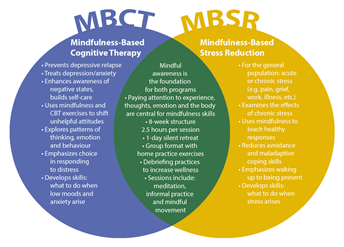
Mindfulness-Based Cognitive Therapy (MBCT) vs. Mindfulness-Based Stress Reduction (MBSR)
Mindfulness-Based Cognitive Therapy (MBCT) and Mindfulness-Based Stress Reduction (MBSR) are two mindfulness programs designed to improve mental health and well-being, yet they cater to distinct needs. Both programs share a foundation in mindful awareness, fostering skills to pay attention to thoughts, emotions, and bodily sensations in the present moment. They follow an 8-week structure with 2.5-hour sessions, a 1-day silent retreat, and group-based exercises incorporating meditation, mindful movement, and informal practices.
MBCT, primarily aimed at individuals with depression and anxiety, combines mindfulness techniques with elements of Cognitive Behavioral Therapy (CBT). It emphasizes enhancing awareness of negative thought patterns, exploring emotional and behavioral responses, and fostering self-care. MBCT equips individuals with tools to recognize and shift unhelpful attitudes, empowering them to respond more effectively to low moods and anxiety. The approach is particularly effective in preventing depressive relapse and improving emotional resilience.
On the other hand, MBSR is designed for the general population experiencing acute or chronic stress, such as pain, grief, or work-related pressures. It examines the impacts of chronic stress and teaches healthy responses through mindfulness practices. MBSR focuses on reducing avoidance behaviors and maladaptive coping strategies, helping individuals wake up to the present moment and develop constructive ways to handle stress.
Both MBCT and MBSR are transformative programs, offering structured, evidence-based approaches to managing mental health challenges and promoting a greater sense of balance and well-being. While MBCT is more therapeutic and clinical, MBSR leans toward stress reduction and overall wellness. Their shared practices and tailored focuses make them invaluable tools for personal growth.
Data on Depression in India
According to the National Mental Health Survey (2015-16) conducted by NIMHANS:
Lifetime Prevalence: 5.25% of Indians experience depression at some point.
Treatment Gap: 75%-85% of those affected do not receive adequate care.
Relapse Rates: Without intervention, relapse rates in recurrent depression exceed 50%.
These statistics highlight the critical need for effective therapies like CBT and MBCT.
In Short:
CBT and MBCT are invaluable tools in the fight against depression. While CBT is highly effective for acute depression, MBCT excels in preventing relapse and fostering long-term emotional resilience. The choice between these therapies depends on individual needs, the nature of depression, and personal preferences. With increasing availability of resources like MBCT therapy PDFs, worksheets, and training courses in India, individuals now have more options than ever to embark on their journey to mental well-being.
Stress has become an inevitable part of modern life. Whether it’s caused by work deadlines, family responsibilities, or unexpected life events, it can leave us feeling overwhelmed and drained. But what if there was a way to manage stress effectively by changing how we think and act? Cognitive Behavioural Therapy (CBT) offers practical tools to reframe negative thoughts and develop healthy coping mechanisms. Below, we explore seven effective CBT techniques for managing stress, with relatable examples to help you incorporate them into daily life.
1. Cognitive Restructuring
Cognitive restructuring involves identifying and challenging negative thought patterns. For instance, if you often think, “I’ll never meet this deadline,” this technique encourages you to analyse the evidence for and against that belief. Ask yourself, “What’s the evidence for this thought? Have I successfully managed tight deadlines before? Or Have I missed a deadline before?”
Replace it with a balanced thought like, “I’ve met tight deadlines before, and I can plan effectively to handle this.”
Application: If you’re searching for stress management counselling near me, a therapist can guide you through this process and help reframe persistent negative thoughts.
2. Thought Records
A thought record is a structured journal where you document stressful situations, associated emotions, and the automatic thoughts that arise. By reflecting on these entries, you can recognize recurring patterns and develop healthier responses.
Example: Imagine feeling overwhelmed at work. By writing down your thoughts, you might notice that perfectionism is driving your stress. In order to benefit from these techniques, consider reaching out to a trained counselor or therapist. Searching for a psychiatrist near me can also help you access professionals who can assess your needs and recommend therapy or other interventions to manage stress effectively.
3. Behavioural Activation
Stress often causes us to withdraw or avoid tasks, which can worsen the situation. Behavioral activation encourages engaging in pleasant, goal-oriented activities to counteract this tendency.
Practical Tip: If stress makes you avoid a difficult conversation, set a small, achievable goal like writing down your key points first. Taking small steps builds momentum and reduces avoidance. For individuals seeking counselling for stress management, this technique is a cornerstone of recovery.
4. Progressive Muscle Relaxation (PMR)
PMR is a relaxation technique where you tense and release muscle groups sequentially to reduce physical tension and overthinking.
Scenario: Before a high-pressure presentation, practicing PMR can help calm your nerves. Stress management counselling doctors in Noida often recommend this method to alleviate anxiety quickly.
5. Mindfulness-Based Techniques
Stress can pull us into a whirlwind of overthinking. Mindfulness teaches us to stay present and observe our thoughts without judgment.
Try This:
Practice deep breathing: Inhale for 4 counts, and exhale for 8 counts.
Engage your senses: Focus on objects you can see, hear, and feel around you to bring yourself back to the present moment.
Everyday Use: Feeling overwhelmed by tasks? Take five minutes to focus on your breathing. This can reset your mental state and increase productivity.
6. Activity Scheduling
This technique helps organize tasks and integrate enjoyable activities into your routine, countering the chaos of stress.
Example: Break a daunting project into smaller steps with specific deadlines. Scheduling small breaks for enjoyable tasks can also boost motivation.
7. Problem-Solving Training
CBT teaches structured problem-solving to address stressors systematically. Steps include identifying the problem, brainstorming solutions, and implementing the best one.
Practical Application: Struggling with work-life balance? List specific issues, such as workload or household responsibilities, and brainstorm strategies like delegating tasks or setting boundaries.
How CBT Helps with Stress Management
CBT provides tools to address both the root causes and symptoms of stress. Techniques like cognitive restructuring and behavioural activation enable individuals to regain control over their thoughts and actions. Seeking stress management counselling doctors in Noida or exploring best CBT practices online can accelerate this process.
Stress can significantly impact your mental and physical health, but professional help is just a click away. If you’re seeking online CBT (Cognitive Behavioral Therapy) stress management doctors in Noida, you’ll find highly experienced specialists offering tailored solutions to help you regain control of your life.
CBT is a proven therapeutic approach that focuses on identifying and reframing negative thought patterns, replacing them with healthier, positive behaviors. It is particularly effective for stress management, helping you tackle everyday challenges with resilience and clarity.
The top online CBT stress management doctors in Noida use evidence-based techniques to create a personalized therapy plan for you. Techniques like mindfulness, relaxation strategies, thought record analysis, and gradual exposure to stress triggers empower you to handle stress more effectively.
Online therapy offers the flexibility to connect with experienced psychologists and psychiatrists from the comfort of your home, ensuring convenience without compromising on care. Whether you’re dealing with work-related stress, personal challenges, or general anxiety, these specialists are here to support you.
Take the first step toward stress relief and better mental well-being. Connect with the best online CBT stress management doctors in Noida today and start your journey to a healthier, happier you!
FAQs
How does CBT reduce stress?
CBT helps identify and change negative thought patterns and behaviours, offering practical tools like relaxation techniques and problem-solving strategies.
Who can benefit from stress management counselling?
Anyone experiencing chronic stress, anxiety, or related issues can benefit, including those looking for a psychiatrist near me.
What’s the role of mindfulness in CBT for stress?
Mindfulness promotes present-moment awareness, reducing stress and improving focus.
Are CBT techniques effective for workplace stress?
Yes, CBT techniques like cognitive restructuring and activity scheduling are particularly helpful for managing workplace demands.
Can I learn CBT techniques on my own?
While self-help resources are available, working with professionals through counselling for stress management ensures personalized guidance and better outcomes.
Cognitive Behavioural Therapy (CBT) is a structured, evidence-based approach designed to address negative thought patterns and behaviours. It is highly versatile, offering both individual and group formats to meet the diverse needs of clients. While each method has unique benefits, both play a pivotal role in supporting mental health and personal growth. This article explores the advantages of group and individual therapy in CBT and helps identify which might be the most beneficial for specific circumstances.
Understanding CBT Therapy
CBT focuses on identifying and changing unhelpful thought patterns and behaviours. It is widely used to treat conditions such as anxiety, depression, PTSD, and phobias. Whether engaging with a CBT therapist in India or attending sessions with the best CBT therapist online, clients can choose between group and individual formats based on their preferences and therapeutic goals.
Benefits of Individual Therapy in CBT
Individual therapy involves one-on-one sessions between a client and a therapist. This personalized approach allows for:
1. Tailored Interventions:
In individual CBT, the therapist creates a customized treatment plan that directly addresses the client’s unique concerns. For instance, someone working with the best cognitive behavioural therapy doctor in Noida may focus specifically on overcoming social anxiety or managing intrusive thoughts.
2. Privacy and Confidentiality:
Individual sessions provide a safe space where clients can share sensitive information without fear of judgment. This can be particularly important for individuals dealing with trauma or deep-seated issues.
3. Deeper Exploration:
Therapists can dive deeper into the client’s cognitive distortions and behavioural patterns. For example, a client struggling with negative self-perceptions might explore how these thoughts originated and develop strategies to reframe them.
4. Flexible Pacing:
Clients set the pace of their therapy sessions. A therapist can adjust the speed and depth of interventions based on the client’s progress and readiness, ensuring they don’t feel overwhelmed.
Benefits of Group Therapy in CBT
Group therapy involves multiple participants working together under the guidance of a therapist. This format has several unique advantages:
1. Peer Support and Connection:
Group therapy fosters a sense of community. Participants realize they are not alone in their struggles, which can be incredibly empowering. For instance, individuals attending a cognitive behavioural therapy clinic near me might share their experiences with anxiety, learning from others’ coping strategies.
2. Learning Through Shared Experiences:
Hearing others’ stories can offer new perspectives and solutions. Participants often gain insights into their own challenges by observing how others tackle similar issues.
3. Skill Practice in a Safe Environment:
Group settings provide opportunities to practice social skills and assertiveness in real-time. For example, a group member working on communication might role-play a difficult conversation with peers.
4. Cost-Effective Option:
Group therapy is often more affordable than individual sessions, making it accessible to a broader range of individuals.
Comparing Group and Individual CBT Therapy
While both formats share the goal of improving mental health, their approaches differ:
Aspect
Individual Therapy
Group Therapy
Focus
Personalized, in-depth exploration
Broad, community-based learning
Pace
Client-driven
Structured to suit the group’s needs
Interaction
One-on-one with the therapist
Collaborative with peers and therapist
Cost
Generally higher
More affordable
Skill Practice
Limited to therapist interaction
Includes peer-based skill application
Combining Both Formats for Maximum Benefit
Many clients find that combining individual and group therapy maximizes the benefits of CBT. For example:
Individual Therapy for Deep Work: Clients can focus on personal challenges and long-term goals in one-on-one sessions with the best CBT therapist online.
Group Therapy for Skill Building: Group sessions allow clients to practice new skills in a supportive environment and gain diverse perspectives.
The choice between group and individual CBT therapy depends on factors such as:
Nature of the Issue: Deeply personal or traumatic experiences may be better addressed in individual therapy. On the other hand, challenges like social anxiety might benefit more from group interactions.
Budget and Accessibility: Group therapy is often more cost-effective. Searching for a cognitive behavioural therapy clinic near me can help identify local group options.
Comfort Level: Some individuals prefer the privacy of individual sessions, while others thrive in group settings.
Therapeutic Goals: If the goal is to develop interpersonal skills or combat feelings of isolation, group therapy may be ideal.
In Short
Both individual and group therapy offer unique benefits in CBT. While individual therapy provides a tailored, private space for deep exploration, group therapy fosters connection and shared learning. Clients can consult a CBT therapist in India or the best cognitive behavioural therapy doctor in Noida to determine the format that best suits their needs.
For those seeking accessible options, the best CBT therapist online can offer flexibility and convenience. Whether working individually or in a group, CBT therapy is a powerful tool for transforming negative thought patterns and achieving mental well-being.
FAQs
What are the key benefits of combining individual and group CBT therapy? Combining both formats allows clients to benefit from the personalized focus of individual therapy and the community learning of group sessions. This approach helps clients achieve deeper insights and practice skills in a supportive environment.
When should I choose group therapy over individual CBT therapy? Group therapy is ideal if you aim to build social skills, reduce feelings of isolation, or prefer a more affordable option. It’s also beneficial for issues like social anxiety, where interacting with peers can provide valuable practice and support.
Can I switch between individual and group CBT therapy during treatment? Yes, many therapists recommend integrating both formats depending on your evolving needs and goals. You can discuss this option with your therapist to ensure the best approach for your progress.
How do I find group CBT therapy options near me? Searching online for a cognitive behavioural therapy clinic near me can help you locate local group therapy programs. Consulting with a CBT therapist can also guide you to group sessions tailored to your needs.
Is online CBT therapy effective for both individual and group sessions? Absolutely! The best CBT therapist online offers flexible and accessible options for both formats, allowing clients to choose what works best for their schedules and preferences.