Mapping the Mind’s Minefields: The 10 Cognitive Distortions and How to Neutralize Them
In our previous exploration of the “Unseen Architect,” we discovered that our emotional reality is not a direct reflection of the world, but a construction of our thoughts. We learned that between an event and our emotional reaction lies a filter—a cognitive interpretation that determines whether we feel calm or crushed. However, for many of […]
In our previous exploration of the “Unseen Architect,” we discovered that our emotional reality is not a direct reflection of the world, but a construction of our thoughts. We learned that between an event and our emotional reaction lies a filter—a cognitive interpretation that determines whether we feel calm or crushed.
However, for many of us, that filter has become warped over time. Imagine trying to navigate a beautiful landscape while wearing glasses that blur the edges, darken the colors, or magnify every tiny pebble into a jagged mountain. In psychology, we call these warped lenses Cognitive Distortions.
These are not “faulty” parts of your personality; they are simply survival-based shortcuts the brain takes when it feels under threat. But when these shortcuts become our default setting, they create a minefield of emotional pain. Today, we will map the ten most common minefields and, more importantly, learn how to neutralize them.
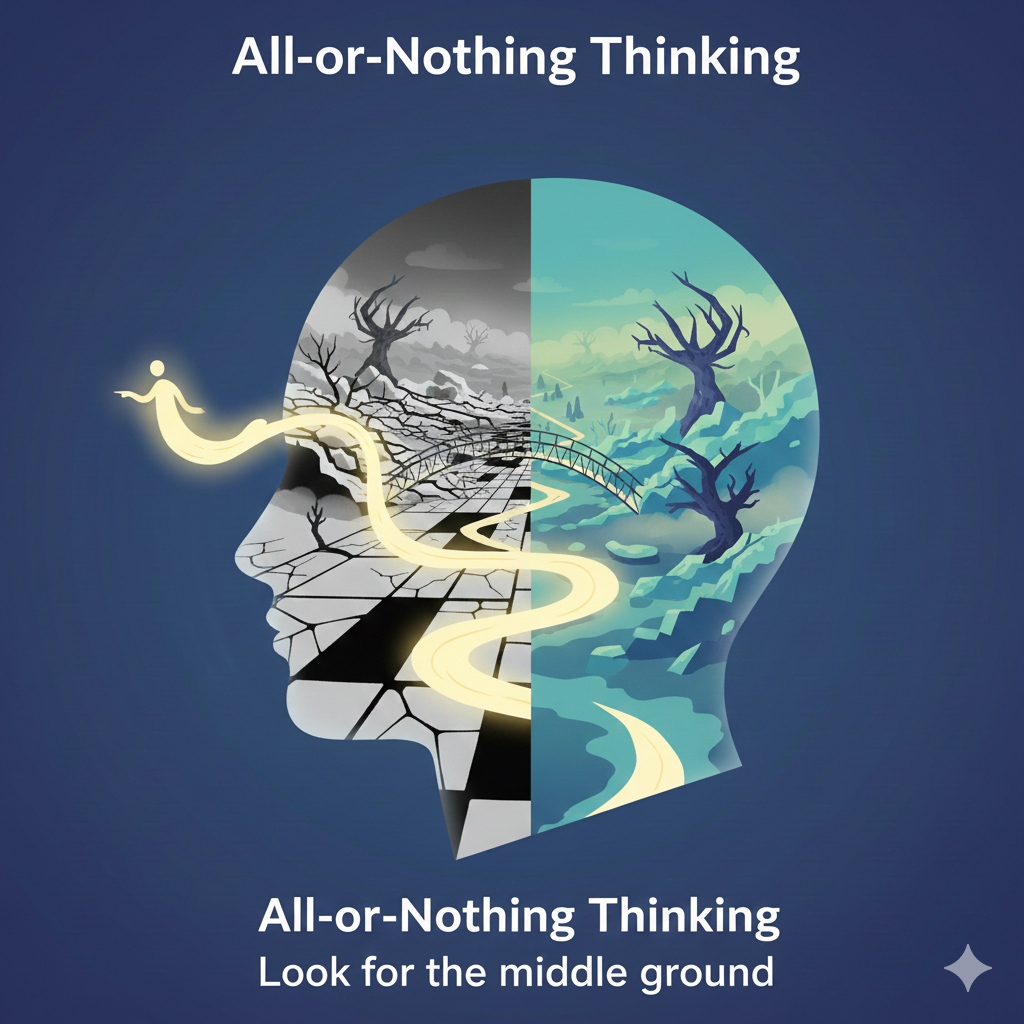
1. All-or-Nothing Thinking (The Binary Trap)
This is the tendency to see things in black-and-white categories. If a situation falls short of perfect, you see it as a total failure.
The Minefield: “If I don’t get an ‘A’ on this project, I’m a complete loser.”
The Neutralizer: Search for the “Gray Area.” Life rarely exists at the extremes. Ask yourself, “On a scale of 0 to 100, where does this actually land?” Even a 60 is more than 50% grade, not a zero.
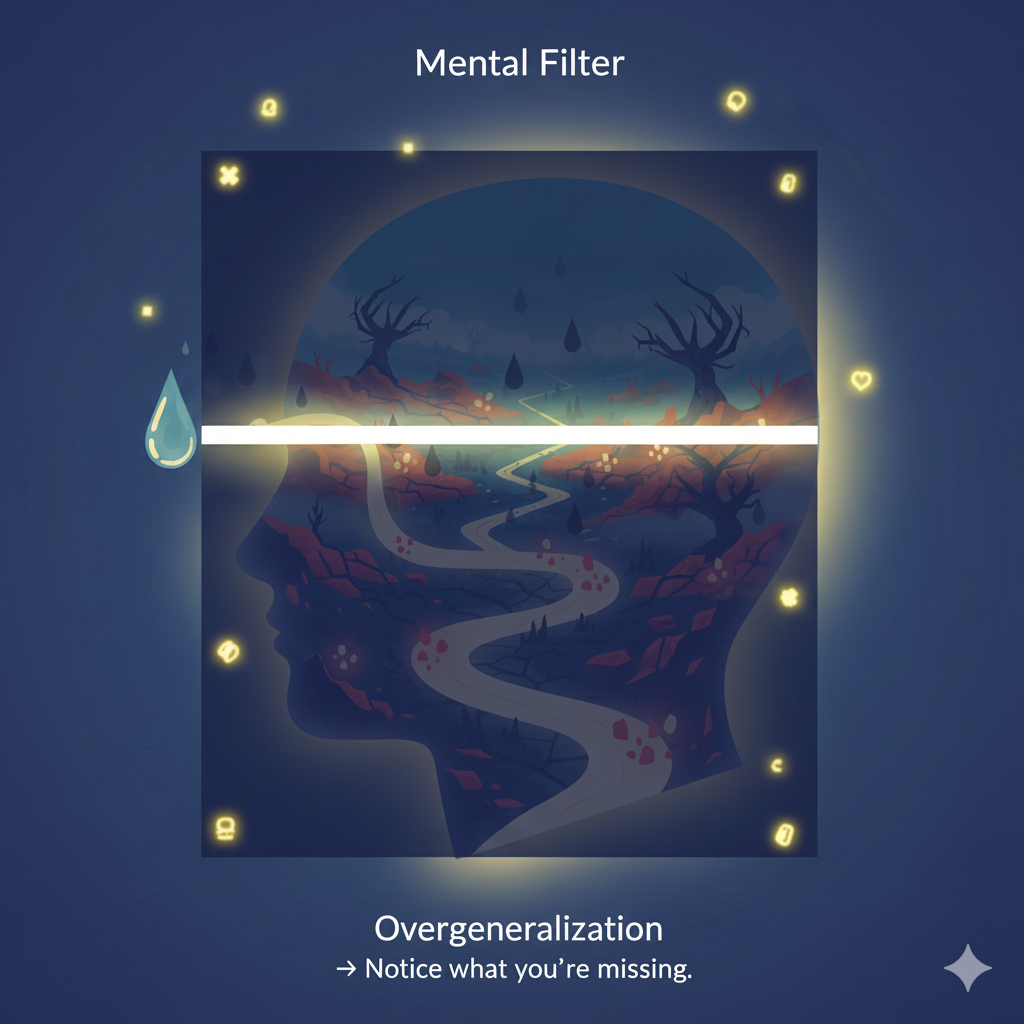
2. Overgeneralization (The “Always” Filter)
You see a single negative event—such as a romantic rejection or a professional setback—as a never-ending pattern of defeat. You often use the words “always” or “never.”
The Minefield: “I tripped during my speech; I always embarrass myself.”
The Neutralizer: Look for the counter-evidence. Have there been times you didn’t trip? Or delivered a part successfully. Treat the event as a single, isolated data point rather than a permanent law of nature.
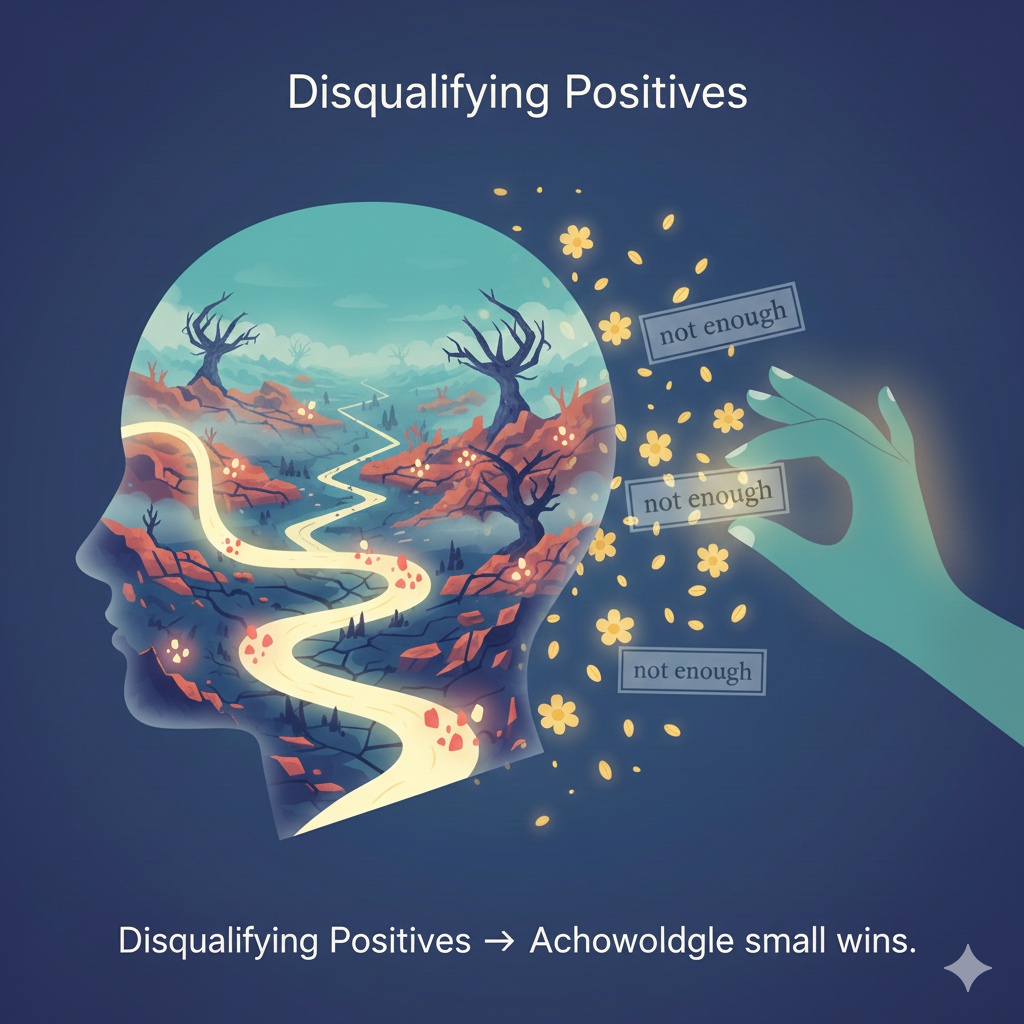
3. Disqualifying the Positive (The Shield)
This is more active than the Mental Filter. You don’t just ignore positive experiences; you transform them into negatives by telling yourself they “don’t count.”
The Minefield: “They only complimented my work because they’re being nice, not because I’m actually good.”
The Neutralizer: Practice “Radical Acceptance” of compliments. When a positive fact arrives, let it land. Say, “Thank you,” to yourself and the other person, and resist the urge to explain it away.
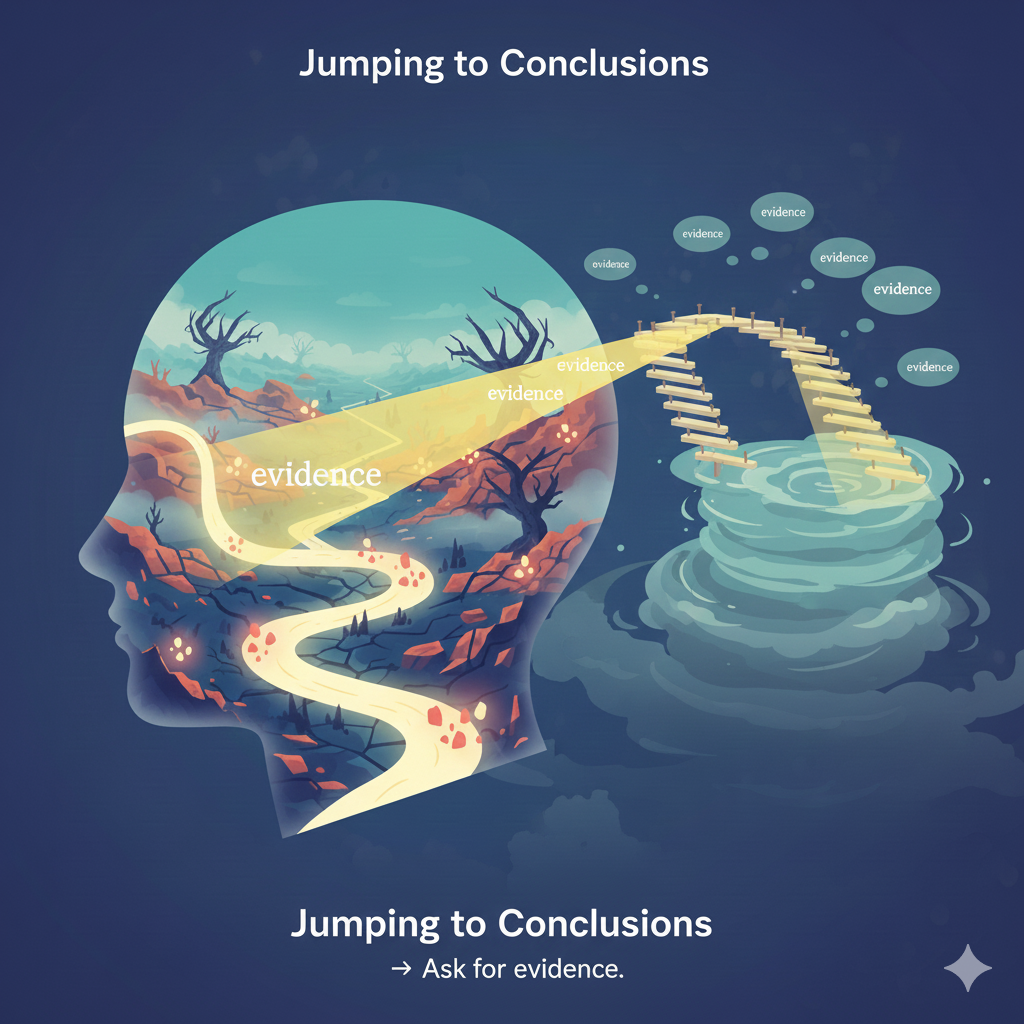
4. Jumping to Conclusions (The Mind Reader & Fortune Teller)
You make a negative interpretation even though there are no definite facts that convincingly support your conclusion.
The Minefield:Mind Reading (“He didn’t say hi, so he must be mad at me”) or Fortune Telling (“I know I’m going to have a terrible time at the party”).
The Neutralizer: Ask for the evidence. “Is this a fact I know, or am I guessing?” Remind yourself that thoughts are hypotheses, not facts.
5. Magnification (Catastrophizing)
You blow things out of proportion. This is often called the magnification—looking at your flaws through the magnifying lens.
The Minefield: “I made a typo in the email; the client will fire the firm and I’ll be homeless.”
The Neutralizer: The “Perspective Shift.” Ask: “What is the worst that could actually happen, and how would I cope if it did?” Usually, the “catastrophe” is a manageable inconvenience.
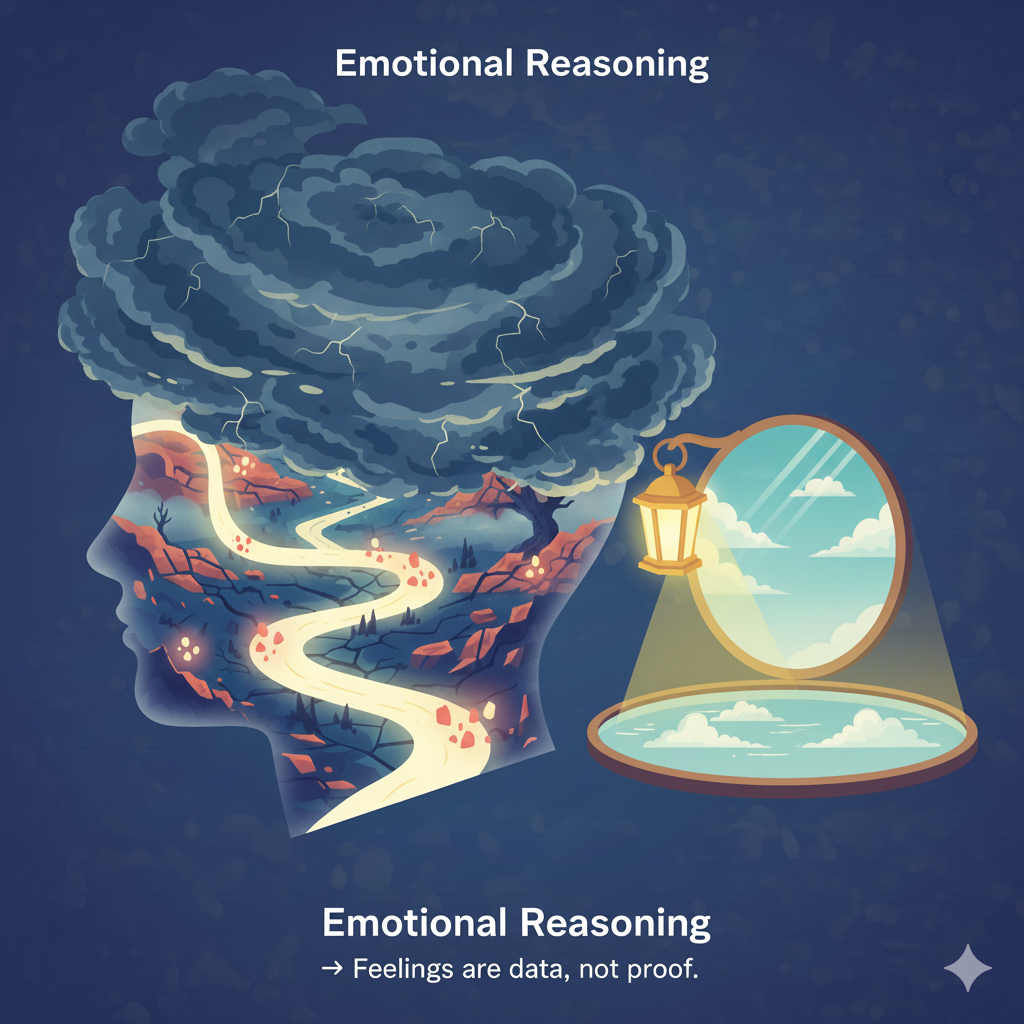
6. Emotional Reasoning (The Feeling-is-Fact Fallacy)
You assume that your negative emotions necessarily reflect the way things really are: “I feel it, therefore it must be true.”
The Minefield: “I feel like a fraud, so I must be an impostor.”
The Neutralizer: Separate “Feeling” from “Being.” Use the sentence: “I am having the feeling of being a fraud, but the facts show I am qualified.” Emotions are messengers, not judges.
7. “Should” Statements (The Guilt Whip)
You try to motivate yourself with “shoulds” and “shouldn’ts,” as if you were a prisoner who had to be punished before you could do anything.
The Minefield: “I should be over this by now,” or “I shouldn’t feel sad.”
The Neutralizer: Replace “Should” with “I would like to” or “It would be helpful if.” This shifts the energy from shame-based pressure to value-based choice.
8. Labeling (The Identity Stamp)
Instead of describing your error, you attach a negative label to yourself: “I’m a loser” instead of “I made a mistake.”
The Minefield: “I’m a failure,” after losing a single client.
The Neutralizer: Stick to the verbs. You are not a “Failure” (a noun); you “failed at a specific task” (a verb). You are a complex, evolving human being, not a static label
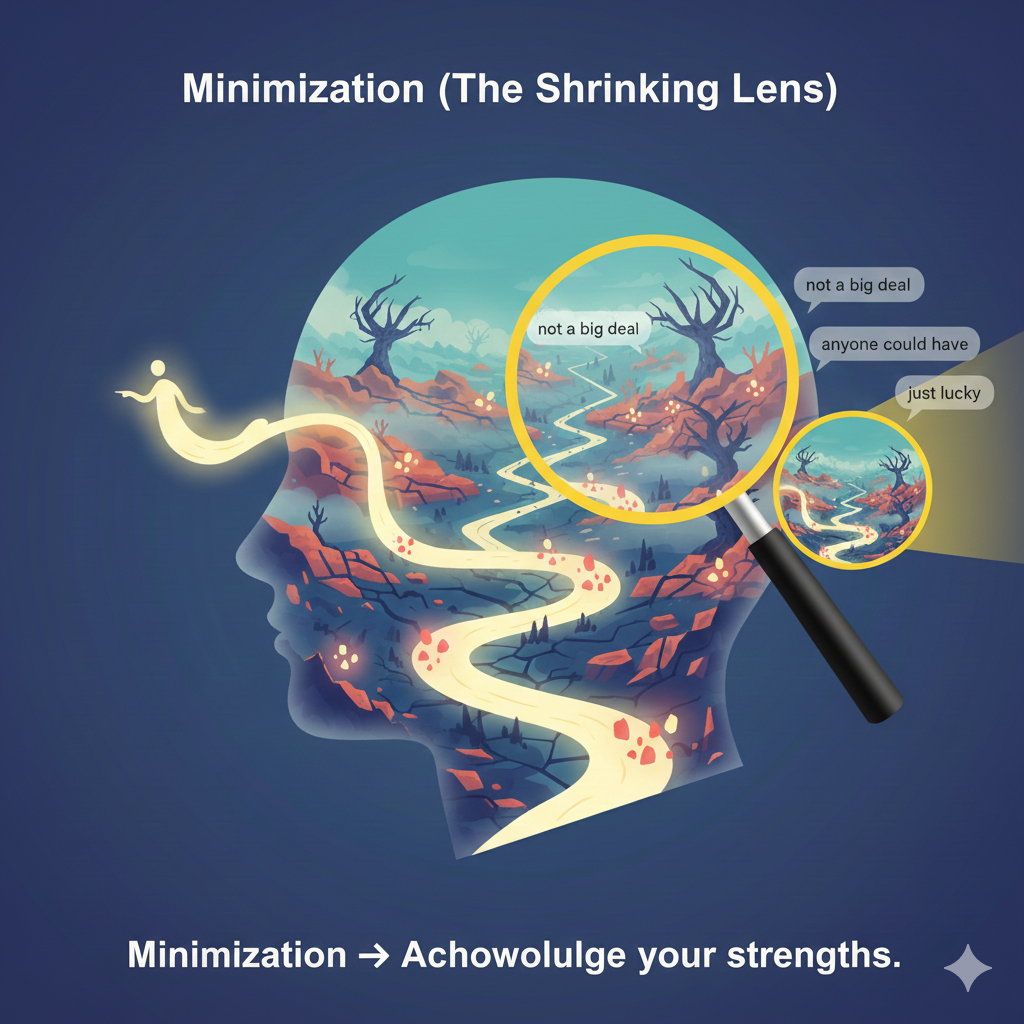
9. Minimization (The Shrinking Lens)
While “Magnification” blows things out of proportion, “Minimization” does the opposite: it shrinks your strengths, your accomplishments, and your available resources until they appear tiny and insignificant.
The Minefield: You successfully navigate a complex crisis at work, but you tell yourself, “It wasn’t a big deal, anyone could have done it,” or you ignore the fact that you have the skills to handle a current challenge.
The Neutralizer: The “Fact-Check.” Imagine a colleague had achieved what you just did—would you tell them it was “nothing”? Practice acknowledging your skills as objective tools in your kit, rather than dismissing them as “accidental.”
10. Personalization (The Responsibility Burden)
You see yourself as the cause of some negative external event for which, in fact, you were not primarily responsible.
The Minefield: “My team didn’t hit the target; it’s entirely my fault for not being a better leader.”
The Neutralizer: “The Pie Chart of Responsibility.” If a project fails, draw a circle. How much was the economy? How much was the timeline? How much was the client? You will find your slice is much smaller than you thought.
From Recognition to Regulation
Identifying these minefields is the first and most vital step toward reclaiming your emotional life. As we have seen, the “Unseen Architect” within us often works on autopilot, using these ten distortions to build a reality that feels much harsher than the facts warrant.
This perspective shift is what breaks the cycle of the CBT Triangle. When you intervene at the level of the “Thought,” you stop the automatic cascade into painful emotions and reactive behaviors. You transition from being a passive inhabitant of your mind’s minefields to becoming the active surveyor of your own mental landscape.
Your Practice for the Week
Emotional freedom is not built in a day; it is built through consistent, small moments of awareness. Don’t try to dismantle every distortion at once. Instead, pick one “minefield” from this guide that feels most familiar to your daily life.
For the next seven days, simply aim to “catch” it in the wild. When you hear that inner voice starting to build a prison out of “shoulds,” “labels,” or “minimizations,” simply name it: “Ah, there is the All-or-Nothing minefield.” In that single moment of naming, you strip the distortion of its power. You create a precious second of space where your logic can catch up to your impulse. In that space, you are no longer trapped by an automatic story; you are free to choose a more balanced, realistic, and compassionate way.